Welcome to Hankmo!
Hankmo is located in the municipality of Korsholm, close to the city of Vaasa.
Hopefully you can use the Swedish version of the site, which is more detailed.
Events
Cross-country skiing in Hankmo
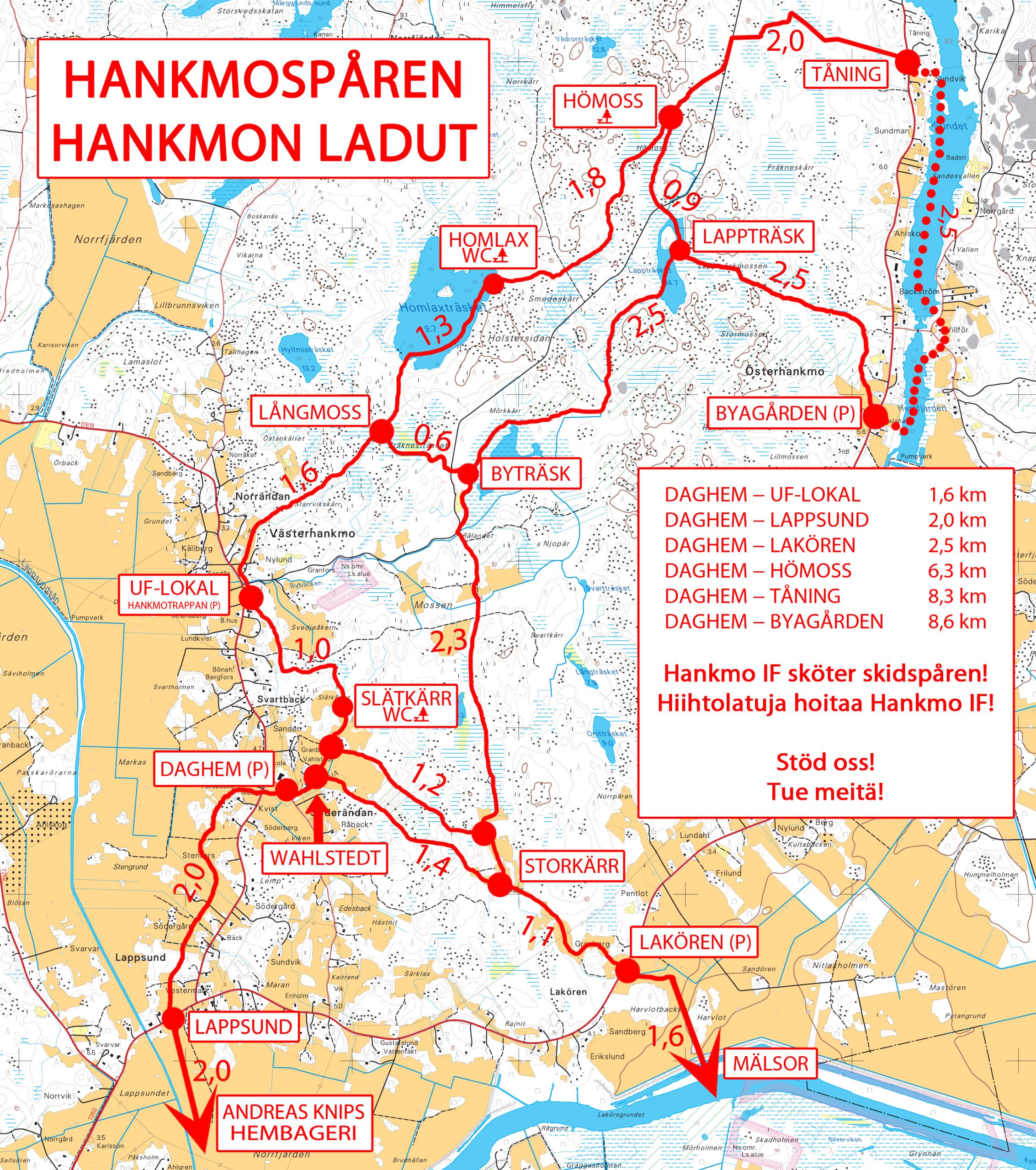
The Hankmo sports club prepares around 30 kilometers of cross-country tracks in the winter season. Check the current status from Facebook or hankmoif.idrott.fi!
The Hankmo Fitness Stairs
In the fall of 2022, Hankmo got its own fitness stairs. You will find the stairs at Västerhankmontie 258 and from there you can find a fire pit and a playground. There is also a barbecue spot at Slätkärr, which you may find 1 kilometer away by taking a forest trail.
The Hankmo Harrow

Johannes Sand (1878–1966), a farmer and blacksmith from Västerhankmo, developed, based on a harrow from Markby in Nykarleby, a propeller-type spade roller harrow with twisted tines whose angle could be adjusted by means of a lever. This adjustability became the invention’s defining feature, and in 1910 Sand was granted a patent. Together with his brother-in-law Anders-Johan Forsberg (1874–1960), he began manufacturing horse-drawn harrows in this smithy. Some stages of production were outsourced to other blacksmiths, including Wahtera in Smedsby and Taipale in Toby. The harrow quickly gained popularity in the region and soon became widely known as the Hankmo Harrow.
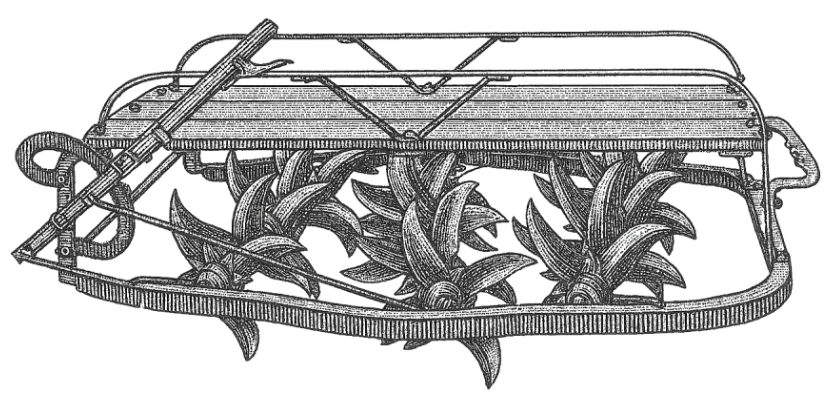
As early as 1911, Sand and Forsberg sold the manufacturing rights to Jakobstad Mechanical Workshop. There, the Hankmo Harrow developed into a major industrial success. During the first decades of Finland’s independence, approximately 300,000 horse-drawn Hankmo Harrows were manufactured and sold in Finland and abroad. When Jakobstad Mechanical Workshop became part of the Wärtsilä Corporation in 1937, development and production continued. The harrows grew steadily in size. By the late 1970s, the Wärtsilä Hankmo 252 required 194 horsepower.
The Hankmo Harrow became so well known that the Finnish verb hankmota was derived from its name. In many parts of Finland, people would say they were going to hankmo whenever they headed out to harrow a field, regardless of whether they were using a genuine Hankmo or a harrow made by another manufacturer.
The inventors did not immediately cease production in the Västerhankmo smithy. Following the land consolidation of Västerhankmo, Sand’s farm was relocated to the southern end of the village between 1912 and 1916. After the relocation, a new smithy was established in Kråksund. However, no harrows were manufactured there. Instead, the workshop was used for repairs and general blacksmithing for local farming needs.
After the First World War, Sand and Forsberg resumed harrow production together with Isak Wahlstedt Jr. (1883–1968). Because the manufacturing rights to the Hankmo name had already been sold, the new model was introduced as the Lucker Harrow, which continued to be manufactured in Västerhankmo until 1925.


Autodigger
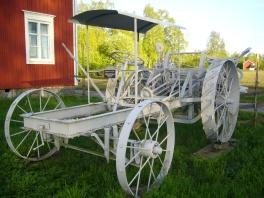
The Autodigger ditching machine was designed by Isak Wahlstedt Jr. (1883–1968). Wahlstedt studied at the Vaasa Industrial School between 1904 and 1906 before emigrating to the United States, where he was employed by the Chicago Flexible Shaft Co., first on the factory floor and later in the drawing office. After returning from America, he began designing a ditching machine in 1912. The machine was advanced for its time, as it was self-propelled and automatically spread the excavated soil to either side of the ditch.
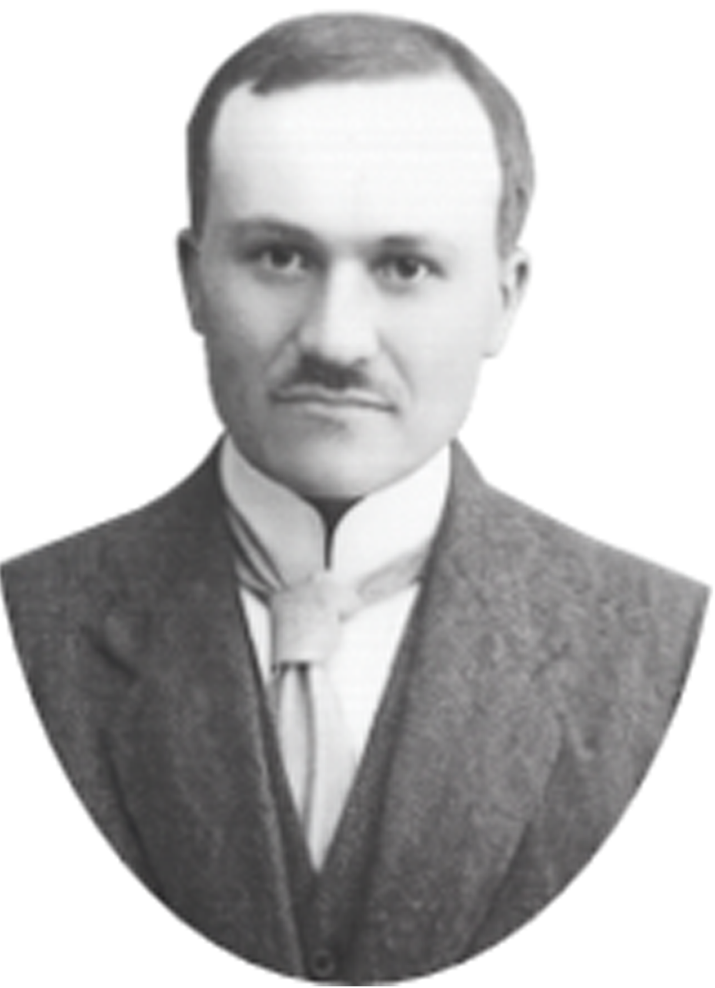
Wahlstedt was granted a patent for the machine on 25 September 1913. That same year, he established a workshop in Västerhankmo and designed an improved version of the machine. This model became known as the Autodigger. It was powered by a specially built 16-horsepower petroleum engine, mounted above the front wheels and manufactured by Bröder Wickströms Motor Factory in Vaasa. Wahlstedt obtained patents for the improved version in Germany in 1913 and Sweden in 1915.
The Autodigger threw the excavated soil 3–4 metres to either side of the ditch. The resulting ditch was approximately 1.2 metres wide at the top, 0.5 metres deep, and 20 centimetres wide at the bottom, producing straight and neatly formed ditches. The size of the ditch could be adjusted by raising or lowering the digging mechanism. The machine excavated approximately four metres per minute, enabling it to dig up to two kilometres of ditch per day. However, the machine was so expensive (6,000 Finnish marks) that it could only be purchased by cooperatives or other organisations, and it never became a commercial success.
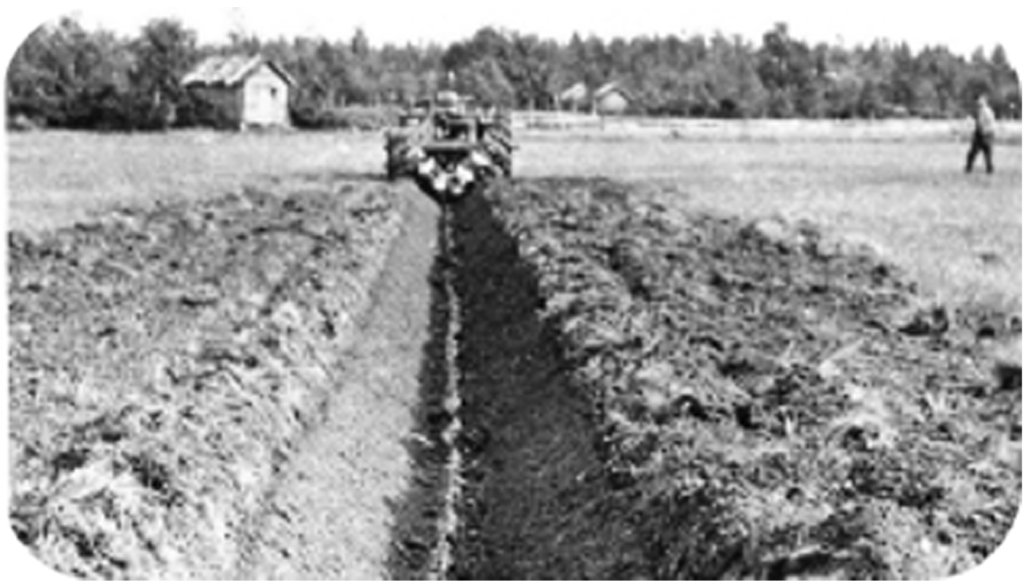
Thr machine performed well on stone-free soil, but on the stony ground typical of this region, problems arose. Stones became lodged between the digging blades and the wings that threw the soil aside, causing the cast-iron wing arms to break. This occurred despite the machine being equipped with a safety mechanism designed to automatically disengage the drive whenever it struck a hard object.
In 1915, Wahlstedt moved to St. Petersburg to work at the factories of L.M. Ericsson and Nobel. There he married Hilma Dahlman in 1916. When the Russian Revolution broke out in 1917, the couple was forced to flee. It is said that they escaped by wading across the border river Sestra. They lost all their possessions and had to start over when they returned to Finland.
Wahlstedt’s mother was the sister of Anders-Johan Forsberg (1874–1960), who, together with Johannes Sand (1878–1966), developed the famous Hankmo Harrow. After the First World War, Wahlstedt joined Forsberg and Sand in developing a new harrow of similar design. However, since the manufacturing rights to the Hankmo Harrow had already been sold, the new model was instead marketed as the Lucker Harrow. The collaboration ended in 1925 when Wahlstedt moved to a larger workshop in Smedsby. Wahlstedt’s son, Wilmer Wahlstedt (1919–2021), later led the development of the first Wärtsilä designed diesel engine. Within the company, the engine became known as the Hankmo Diesel, a tribute to the family’s roots in Västerhankmo.
© The Västerhankmo and Österhankmo joint property associations.